
Surrogate Embryo Transfer Day: What It’s Really Like
At about 8:40 on a Tuesday morning, one of our surrogates propped her phone against a clinic pillow, hit record, and said two words: "Transfer day!" Then she laughed — the nervous, delighted laugh of someone who has spent three months preparing for a ten-minute procedure.
Her video is 37 seconds long. In it you can see the exam room, the ultrasound machine, the monitor with her name and date of birth in the corner, and a woman who is genuinely excited to be lying in a fertility clinic at eight in the morning.
We asked if we could share it, because almost everything written about embryo transfer is aimed at intended parents. Very little of it answers the questions surrogates actually ask: How long does it take? Does it hurt? What am I supposed to do with my bladder? Do I have to lie still for three days afterwards?
This is that answer — the whole day, hour by hour, with the parts most guides skip.
What Embryo Transfer Day Actually Is
Embryo transfer is the moment a fertilized embryo is placed into the uterus. For a gestational surrogate, that embryo was created in a lab from the intended parents' egg and sperm — or from a donor egg or sperm — and has been growing for five or six days. It is typically a blastocyst by the time it is transferred: a hollow ball of roughly 100 to 200 cells.
The surrogate has no genetic connection to the embryo. That is what "gestational" means, and it is the arrangement used in essentially all California surrogacy programs today.
It is also worth saying clearly: transfer day is not the finish line. It sits roughly in the middle of a journey that, start to finish, usually runs 14 to 24 months. Screening, matching, legal contracts and a monitored medication cycle all come first. What happens on transfer day is the visible part of a very long preparation.
The Week Before: Medication, Monitoring, and Logistics
By the time a surrogate reaches transfer day, she has been on medication for weeks. The goal is a uterine lining that is thick, trilaminar (three-layered on ultrasound), and receptive — in the range most clinics describe as 7 to 9 millimeters or better.
| When | What happens | Typical duration |
|---|---|---|
| Cycle day 2–3 | Baseline ultrasound and bloodwork; estrogen begins | 1 visit |
| Next 10–14 days | Estrogen (oral, patch, or injection) to build the lining | Daily or every few days |
| About 10 days in | Lining check ultrasound; progesterone is scheduled once the lining is ready | 1 visit |
| 5 days before transfer | Progesterone starts — intramuscular injections or suppositories, continuing well past transfer | Daily |
| Day before | Final instructions: full bladder protocol, arrival time, who drives, no perfumes or scented products | Phone call |
Two logistics details trip people up more than anything else:
Someone has to drive. Most clinics will not let a patient leave alone, even though no sedation is used. If the surrogate's partner or a family member can be there, plan for it.
The intended parents may or may not attend. Many California clinics allow one or both intended parents in the room; some restrict it to the patient plus one support person. Ask the clinic in advance — it is a bad surprise to discover the answer at the door.
Transfer Day, Hour by Hour

| Time | What happens | How long |
|---|---|---|
| T-minus 60 min | Drink 16–32 oz of water and do not empty your bladder. A full bladder pushes the uterus into a better position for the ultrasound and flattens it so the catheter path is straighter. | — |
| Arrival | Check-in, ID verification, vitals. Some clinics draw blood to confirm progesterone levels. | 15–20 min |
| Pre-op | Change into a gown. The embryologist confirms the embryo ID with a second staff member — you will often be asked to state your name and date of birth out loud as a double check. | 15–20 min |
| Setup | Positioned on the table. Abdominal ultrasound is placed to map the uterus and measure the catheter path. | 5–10 min |
| The transfer | A speculum is placed, the cervix is cleaned, and a thin soft catheter is threaded through the cervix into the uterus. The embryologist loads the embryo into the catheter in the lab and hands it through a pass-through window. The embryo is deposited about 1–2 cm from the fundus. | 5–10 min |
| Rest | Lying flat, usually with a wedge under the hips. Some clinics give a few minutes of "quiet time" and an ultrasound photo. | 15–30 min |
| Discharge | Dress, empty your bladder (finally), and go home. No restrictions beyond avoiding heavy lifting and strenuous exercise. | 10 min |
Add it up: the procedure that everything has been building toward takes less time than the drive to the clinic.
What the Transfer Actually Feels Like
Most surrogates describe it as comparable to a Pap smear — pressure, a cold sensation from the speculum and the cleansing solution, and perhaps mild cramping when the catheter passes the cervix. No sedation is used, and no incisions are made.
If you ask surrogates what the worst part of the morning was, the honest answer is usually the full bladder. An hour of deliberately not using the bathroom, followed by lying still on a table, is genuinely uncomfortable. It is also over quickly.
One detail worth knowing: you may feel nothing at all during the actual placement. The uterus does not have pain fibers in the same way the cervix does. Many surrogates say the moment they expected to feel most was the moment they felt least.
What You See on the Ultrasound
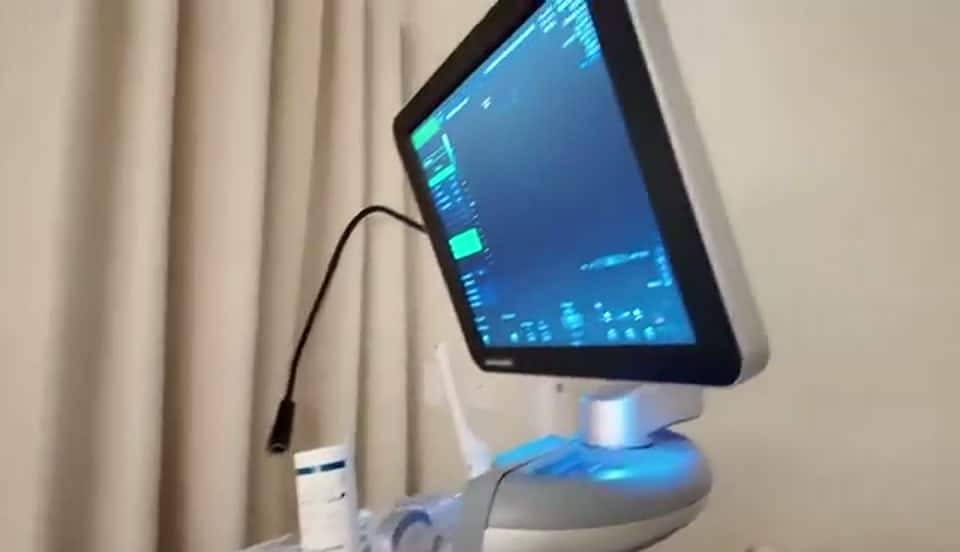
The ultrasound screen is the part surrogates remember. You see your own uterus in cross-section, the faint white line of the catheter advancing, and then — often — a small bright flash. That flash is the tiny amount of culture medium and air surrounding the embryo, and it is the visual confirmation that the catheter reached the right place.
In our surrogate's video, the monitor in the exam room reads Huntington Reproductive Center — the Los Angeles clinic where her transfer took place. Her name and date of birth are visible in the corner of the screen, which is standard practice: every step of the embryo's chain of custody is verified against the patient in the room.

Who Is in the Room
A typical transfer involves four people:
- The reproductive endocrinologist — performs the transfer
- The embryologist — prepares and loads the embryo, usually working behind a pass-through window or in an adjacent lab
- A nurse or medical assistant — supports the patient, manages the ultrasound, verifies identity
- The surrogate — and, where the clinic allows it, one support person or the intended parents
It is a small, quiet, highly scripted procedure. Everyone in the room says the patient's name and date of birth out loud more than once. That repetition is not bureaucracy — it is the safety system that prevents the wrong embryo from being transferred.
After the Transfer: The Two-Week Wait
Here is the part where folklore and evidence diverge most sharply.
You do not need bed rest
The American Society for Reproductive Medicine has reviewed the evidence on post-transfer bed rest and does not recommend it. Prolonged immobilization has not been shown to improve implantation rates, and several studies have associated it with worse outcomes and higher stress. Walking around, going to the bathroom, and sleeping normally are all fine. What clinics do ask for is a few days without heavy lifting, high-impact exercise, hot tubs, or saunas.
Progesterone continues — it is not optional
The medication protocol does not stop at transfer. Progesterone support usually continues for 8 to 10 weeks of pregnancy. Missing doses is the single most common avoidable problem in this window.
The pregnancy test comes 9 to 14 days later
A blood test for beta hCG confirms whether implantation occurred. Timing varies by clinic and by the embryo's development day. If it is positive, an ultrasound follows at around six to seven weeks to confirm a heartbeat. If it is negative, the clinic reviews the cycle and adjusts the protocol before the next attempt.
Early symptoms are the medication, not the pregnancy
This deserves its own line because it causes real distress. Bloating, breast tenderness, fatigue, and cramping in the days after transfer are overwhelmingly caused by progesterone. They are not a reliable sign either way — and reading them as one is how the two-week wait becomes unbearable.
What Transfer Day Costs a Surrogate: Nothing
Every medical cost of the cycle — medications, monitoring, the transfer itself, and the legal work — is covered by the intended parents or the agency. A surrogate never pays for her own screening, medication, travel, or legal representation.
In California this is not just customary, it is statutory. Under California Family Code §7962, the surrogate must have her own independent attorney, paid for by the intended parents, and the agreement must be fully executed before any medication begins. That protects both sides: the surrogate is not relying on the agency's lawyer to explain her rights.
Compensation is structured separately — monthly installments plus milestone payments, with transfer day falling inside the first milestone. The full breakdown is in our guide to surrogate compensation in California.
Frequently Asked Questions
How long does an embryo transfer take?
The procedure itself takes about 5 to 10 minutes from speculum to completion. Including check-in, preparation, the transfer, and the recovery period afterwards, expect to be at the clinic for roughly two hours.
Does embryo transfer hurt?
Most surrogates describe it as similar to a Pap smear: pressure, mild cramping, and no sedation. The full bladder required for ultrasound guidance is usually the most uncomfortable part of the morning.
Can the intended parents be in the room?
Often yes, but policies vary by clinic and by whether the transfer is a first attempt. Ask the clinic before the appointment rather than at the door. Many clinics allow one support person in addition to the intended parents.
Do I have to stay in bed after embryo transfer?
No. ASRM does not recommend bed rest after transfer, and research has not shown it improves implantation. Normal activity, including walking and using the bathroom, is fine. Clinics typically ask you to avoid heavy lifting, high-impact exercise, and hot tubs for a few days.
How soon after transfer will I know if it worked?
A beta hCG blood test is drawn 9 to 14 days after transfer, depending on the clinic and the embryo's development day. If positive, an ultrasound at roughly six to seven weeks confirms a heartbeat.
Can a surrogate go back to work the next day?
In most cases yes. Many surrogates take transfer day off and return the following day. If the job involves heavy lifting or long periods on your feet, tell your coordinator so the clinic can give specific guidance.
What if the transfer is cancelled?
Occasionally a cycle is cancelled before transfer — if the lining does not respond to medication, or if the embryo does not survive thawing. This is uncommon and is not caused by anything the surrogate did. The clinic adjusts the protocol and schedules another attempt; medication and monitoring costs remain covered.
Thinking About Becoming a Surrogate in California?
If you have given birth at least once, live in California, and are between 21 and 35, you may already meet the basic criteria. The full medical requirements cover a few more details — BMI range, health history, and lifestyle factors.
What we ask of you at the start is small: a short application, a conversation with a coordinator, and no obligation to continue. Everything after that — screening, matching, legal, medication, transfer — is scheduled, paid for, and walked through with you.
Start your surrogate application here — it takes about three minutes, and a coordinator reads every one personally.
This article is general information for people considering gestational surrogacy in California. It is not medical advice. Your clinic's protocol governs your specific cycle; always follow the instructions given by your reproductive endocrinologist.